I have had an amazing time this semester getting to know everyone and being involved in a wonderfully informative class that I will be talking away so much knowledge from. Being a Interior Design major, taking Environmental Biology will most definitely be important to me when I become LEED certified and will give me the ability to help my clients pick out the best environmentally sound way to finish there renovation or design.
The final project, I would have to say, was my favorite part of the semester..aside from all the great biking excursions ;)
Creating the 'I Heart BIKE' design will hopefully generate curiosity and awareness, and be used for fundraisers and other community projects to come is a really great feeling!
Thanks everyone for helping in the whole process, and a special thanks to Kristen for sticking it out with me!!
Hope to see you girls in the future!!
Heather
Showing posts with label media. Show all posts
Showing posts with label media. Show all posts
Monday, May 16, 2011

Tuesday, May 10, 2011
28 day Veg Boot Camp
Hi All,
I read an article on vegetariantimes.com about a new 28 day healthy eating challenge. I thought this fit very nicely into the topics we have discussed in class. Remember back when we went over ecological footprints? If you recall eating meat free can reduce your carbon footprint!

So why not reduce both your ecological footprint and your waistline? Are you feeling adventurous? With the end of the semester, you will be freed from limiting dining hall options, so this challenge may actually be realistic. Give it a try and let us all know how it goes! Link here
I read an article on vegetariantimes.com about a new 28 day healthy eating challenge. I thought this fit very nicely into the topics we have discussed in class. Remember back when we went over ecological footprints? If you recall eating meat free can reduce your carbon footprint!

So why not reduce both your ecological footprint and your waistline? Are you feeling adventurous? With the end of the semester, you will be freed from limiting dining hall options, so this challenge may actually be realistic. Give it a try and let us all know how it goes! Link here
Monday, May 2, 2011
Green Interior Design
Last JanTerm I took an entire class about green design. With my classmates I learned all about what it takes for a building to earn LEED certification and all the different ways people could plan ahead to reduce their impact on the environment. That is why I was so interested to read this article in the Times Herald about all the strides being made towards making home furnishings more environmentally friendly. The article talks about how many carpet scraps are simply discarded in landfills. To combat this issue, there are new floor coverings made of corn-based polymers that use 30% less energy to produce and release 60% fewer emissions during their production. It also mentions paints with few or no VOCs (Volatile Organic Compounds), which damage the atmosphere and can cause health problems for people exposed to them for long periods of time. Finally, the article looks at lighting. It mentions the fact that beginning on January 1, 2012 light bulbs will have to use 25% less energy. This means that traditional light bulbs will not meet the mark and will have to be replaced by compact fluorescent lamps (CFLs) and light emitting diodes (LEDs), which are both 75% more efficient. This law will help to increase efficiency and sustainability but will mean that light bulbs will be more expensive and must be recycled, both things that might be seen as inconvenient to consumers. Overall, these improvements in interior design show that America is headed in the right direction concerning the way that we build and furnish our homes.
Unfortunately this week was too hectic for me to get in any dedicated exercise time. Hopefully things will calm down a bit over the next few weeks and I can resume my walks and bike rides.
Don't LEED Us Astray

Today in class we talked about LEED certification. I found a media article that discussed how wonderful the program is, but explains that a building’s LEED rating is more like a snapshot taken at its opening, not a promise of performance. The article address the need for an frequent renewal process to ensure that the building is remaining energy efficient. It is a great extension about what we talked about in class. Here is the link.
Monday, April 25, 2011
GARDEN!
Everyone, please be so excited about , not only, my mom's garden, but mine!! I planted tomatoes, cucumbers, peppers and tommy toe tomatoes. It is really not all about me, even though I seem to focus on my world! LOL! You have to understand that this is tradition in my family (biggest tomato wins!). This is my first time trying! My dad passed away (he always won) and we are now, this year, in major competetion with the tomatoes. I am sore, sunburned and on a MISSION! I did find an article pertaining to the anger of people from Mexico, living here in the US and the neighbors objecting to them growing food in thier yards. I only read it briefly, however; I will focus on the article's content and relay more details. I am having the best time with this class! Bike ON!
Wednesday, April 20, 2011
Just Read This Headline...
I haven't had a chance to read the article yet, but it ties in to what we were discussing in class on Monday:
http://www.cnn.com/2011/WORLD/asiapcf/04/20/japan.nuclear.reactors/index.html?eref=mrss_igoogle_cnn
http://www.cnn.com/2011/WORLD/asiapcf/04/20/japan.nuclear.reactors/index.html?eref=mrss_igoogle_cnn
Wednesday, April 13, 2011
Food or Fuel?
This week I read an article from the New York Times called “Rush to Use Crops as Fuel Raises Food Prices and Hunger Fears” (which you can read here) by Elisabeth Rosenthal. This article sheds light on the growing biofuel industry and the way it impacts available food crops. There is a rush to convert energy use to biofuel, and in order to produce this biofuel companies need raw materials like corn and sugar cane. Using these crops for fuel rather than food reduces the amount of food available.
The article gives the example of Thailand and the cassava that grows there. Thailand is a developing nation and its cassava supply is an important source of food for its citizens. Unfortunately, cassava is also an important source of biofuel. In 2009, however, 98% of the cassava that was exported from Thailand was sent to China to be made into biofuel, meaning that there was much less of it available to be sold as food to people who depend on it. This contributes to world hunger and increases issues people in these smaller nations already have with nutrition. Additionally, this shrinking food supply increases prices because there is less availability. The United Nations Food and Agriculture Index estimates that food prices rose 15% between October and January alone. This increase put food prices at their highest since the group started tracking them twenty years ago.
Overall, I found this article very interesting because I had not thought about how the increase of the use of biofuel would impact people in different ways. There must be decisions made about whether these crops should be used for food for people in developing nations or if they should be used for fuel. I think that this is an issue that will need to be studied much more before any decisions can be made, but I also feel that it is important for the people growing these crops to benefit from them rather than seeing them made into fuel that they will not be able to use.
This week I went for a walk in my neighborhood for about an hour. I have also been taking a yoga class at Salem, which I really enjoy, in order to fulfill my physical education requirement.
Monday, April 11, 2011
The Role of Human Behavior in Emergent Infectious Diseases


Friday, April 1, 2011
5 Reasons to Care About Where Your Food Comes From


I am working on my own progress report for Wednesday and tinkering with iMovie. I'm realizing I'm no longer happy with the interface, I can not modify the content enough to suit my taste, so I am going to try working in Adobe Premiere, or Final Cut. I learned Final Cut Pro a couple years back when I took a documentary film class at a community television station, but its NOT like riding a bike and I need to re-learn a lot of what I've forgotten. Anyway, I'm working on a first cut of a look at the semester so far, including portions of the vlog and blog entries. On that note, I ask that you please use personal and web posted photos in your blog entries.
Thursday, March 31, 2011
On a Positive Note
This week I read an article entitled “Food: Six Things to Feel Good About” from the New York Times (which you can read here). The author, Mark Bittman, has a weekly column where he discusses different issues relating to food, health and nutrition. Generally, his columns revolve around something that he is upset about or that is particularly disheartening. In this one, however, he takes the time to look at some of the bright spots in the food industry. He looks at things such as the newfound power people are taking in deciding what food they should eat and where it should come from and the Wal-Mart initiative to make their offerings more health-conscious. I enjoyed reading this article because it helped me to see that there are some bright spots to this issue. For instance, I did not know that there are currently 6,000 farmers in the U.S. or that that number is a 250% increase over the number of farmers there were in 1994. I think that is a pretty impressive statistic and shows that people are starting to reclaim responsibility for the food we eat. I also liked hearing about the work that is underway to make school lunches healthier. It is important for good nutrition to be taught to children at a young age and this is a great way to show them how to eat well for the rest of their lives. Overall, I thought that this article touched on a lot of topics that I did not know much about.
Our service project is going well, we have a pretty solid survey created and I think that we have a clear outlook on just where we want to go with it. I am excited to show everyone where we are and see where everyone else is with their projects! I cannot wait to actually send the survey out to people!
Unfortunately, the weather this week has not been very conducive to getting out and biking or walking, so I have not done anything yet. Things are supposed to look better this weekend, so hopefully it will be warm and sunny so I can get in some time outside!
Wednesday, March 30, 2011
Media Article: Why aren't GMO Foods Labeled?
The article I found is called "Why Aren't G.M.O. Foods Labeled", by Mark Bittman. It was in the New York Times online. This article talk about the various reason that genetically modified organisms aren't on the labels. Most of this is because the FDA does not require it to be posted unless it contains more than .9%. This is in part because they do not want to give the impression that these foods are different. However, in England there are strict bans on these foods and they must be labeled. Another concern is that when cross pollination occurs that can no longer be considered organic if it has been genetically engineered. There are concerns arising about genetically engineered salmon, that would be fast growing also. The truth is that most Americans believe that G.M.O.'s are unsafe and that they want them labeled. Not even the strongest supports of G.M.O.'s can say that there aren't hidden dangers.
I have continued to record everything on myplate (Even over spring break). This week however I was off to a rough start, I am currently fighting some sort of viral cold, and there is nothing I can do but let it run its course. I have been working out this week just not running everyday. I hope to be up and running again by this weekend. I will continue to use myplate and hope to hear back from more of the class about possibly participating.
Tuesday, March 29, 2011
Article(s) and old bikes
My article was Urban Gardens Tainted With Lead, Arsenic by David Runk from Huffpost Green. Back-yard and community gardens in Indianapolis, Boston, and New York were tested for lead levels as well as other chemicals that could poison the soil. The research found that 9 out of 10 of the gardens in Indianapolis had high lead levels. In Boston they found 4 out of 5 of the gardens tested had high levels. A non-profit group in two Boston suburbs even had raised beds with freshly composted soil installed, but tests four years later showed that lead content had tripled. Their advice? To continue to test soils, not only when they are first planted, but over the ensuing years. They also suggest washing your hands after gardening to reduce exposure to contaminated soil, to wash vegetables thoroughly, and to avoid tracking soil indoors. Tests on garden beds in NYC have been more promising, finding fewer than 10 percent of them had high lead levels. There have been efforts in the city to bring in clean soil and compost for raised beds.
I also found this article about the "green-ing" of Greensboro:
http://www.washingtonpost.com/lifestyle/travel/the-impulsive-traveler-going-green-in-greensboro-nc/2011/02/24/AFoEhKWB_story.html?wpisrc=emailtoafriend
There was an unexpected death in my family over break, so I went home under different circumstances than planned. I took and found some pics, though:

Me on my bike. I think I was about 7 or 8 in this one. Apparently I could ride a bike and not put myself in mortal danger at the time.

My aunt and uncle's old bikes.
I also found this article about the "green-ing" of Greensboro:
http://www.washingtonpost.com/lifestyle/travel/the-impulsive-traveler-going-green-in-greensboro-nc/2011/02/24/AFoEhKWB_story.html?wpisrc=emailtoafriend
There was an unexpected death in my family over break, so I went home under different circumstances than planned. I took and found some pics, though:

Me on my bike. I think I was about 7 or 8 in this one. Apparently I could ride a bike and not put myself in mortal danger at the time.

My aunt and uncle's old bikes.
The Battle for Biodiversity
 Monsanto has engineered yet another soybean. This one will be resistant to a particular pesticide, that they manufacture. I hope the organic tofu I buy really is organic! What I'm learning as I read more about GMOs and from what I know about plant reproduction is that organic farmers are having a harder time producing truly organic crops. With so many GM crops out there, I can't believe the general public doesn't know more about it, probably because they are found in processed foods, and go undetected.
 La Via Campesina is a farmers' movement of 150 organizations from 70 countries that seeks to protect Biodiversity through seed saving and sharing, something farmers have been doing since we began cultivating crops. In some cases members of this movement break international patent laws to continue this tradition. The idea of patenting life is an odd concept for me to wrap my head around. A mere 10 companies control nearly 3/4 of all seed sales globally. Further, unlike original claims by the manufacturers, these crops are not solving our global food shortages. For instance 3 countries (the United States, Brazil, and Argentina) grow 77% of all genetically modified crops, nearly all destined for livestock, not the world's hungry.
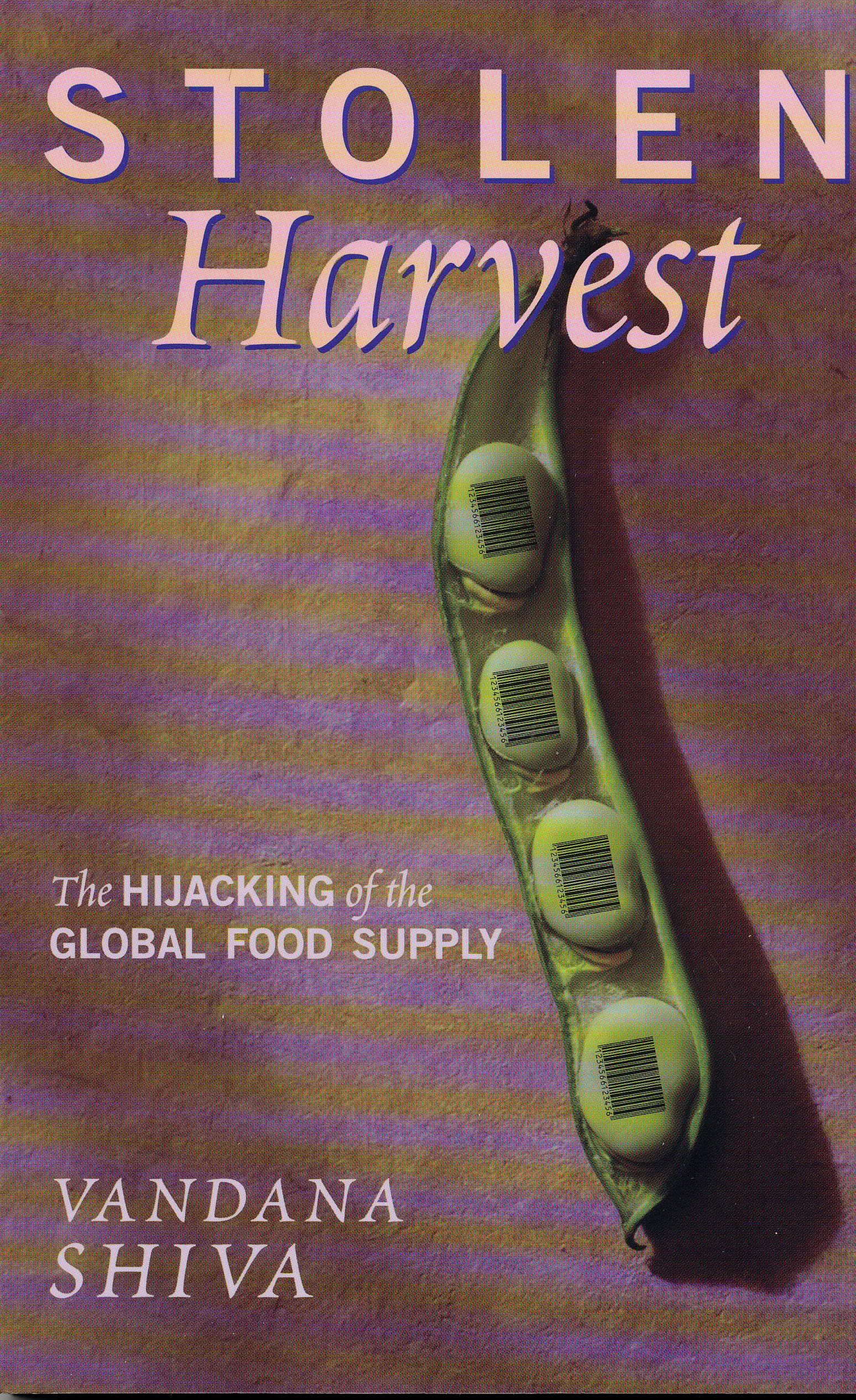 The two camps are on different sides of an ongoing debate. If you are interested in learning more check out the original article. Link to article. You should also consider reading "Stolen Harvest" by Vandana Shiva, a physicist and environmental activist. I had the opportunity to hear her speak when I was an undergraduate at Michigan State University. Shiva has dedicated her life to preserving global food cultures and food security.
 Food Bank Garden
I discovered an exciting article "From Hand-Outs to How-to" that inspired me to grow my own little garden. The article came from Tucson, Arizona published in the Nov.-Dec. 2008 issue in Orion magazine. It was in reference to a food bank. Beside the food bank a seven thousand square foot organic garden was being grown by local people in the community. The garden was filled with tomatoes, beans, chiles and other types of vegetables. They also had chickens that were eating the garden scraps and using their waste for a compost pile. The workshops, for this community, are ongoing for training and they are presented in both English and Spanish. Not only do they train people, they give them the necessary compost piles and tools to get started. They will send someone to your home to select a suitable garden and help you through the process of growing your own food. The community as a whole benefits and the spreading of knowledge will allow the community to become a more economically stable environment. Instead of "how-to handouts", they are actually showing you "How-to". The project is very socially healthy in many aspects. My garden will consist of tomatoes, green peppers, cucumbers and green beans. I am also going to plant tomatoes and peppers at my mom's. Wish me luck! On another note, we are really coming together with our Novant Health project. Things were a little shakey at first due to the break we had last week. Now that we have a clear vision and strategy plan, I am anxious to find out if the calorie counting application can be embraced by other colleges.
Monday, March 28, 2011
Transitioning to Organic Farming
http://www.sciencedaily.com/releases/2011/02/110222140548.htm
My article addressed the concerns of more US farmers that are converting from conventional agriculture to organic production. It appears that more and more farmers are beginning to make this change due to the growing popularity of organic products. This article focused more on the financial implications of such changes and what it would do to the bottom line. The language of the article suggest that going organic may not be very cost effective. This is surprising to me because at the Feed and Seed stores, the organic fertilizer is always cheaper than chemical. I think these farmers were more concerned with the bottom line, as organic crops may not yeild as much as conventional.
Sunday, March 27, 2011
World ‘Dangerously Close’ to Food Crisis, U.N. Says
While the U.N expected a growth in grain yields by 1.2% this year, severe weather in different parts of the world have actually caused a decrease by 2%. The U.N predicts that this fall in production could lead to a global food crisis because there is such a high demand for grain around the world. Shortages in 2007 led to riots in many different countries. While there is currently no crisis, with the shortages continuing to increase we are likely to see the same situation again unless production increases by at least 3.5%. Although corn and seed oil are good fuel alternatives, there use severely decrease the amount of food that is available. Therefore we must consider this in the bills that are passed that subsidize things such as ethanol production. Is it better to have food for the world or a more renewable fuel source?
Link to article
The Novant Health product development group will continue to work on our surveys and will hopefully have them finalized by the end of this week.
Link to article
The Novant Health product development group will continue to work on our surveys and will hopefully have them finalized by the end of this week.
Monday, March 7, 2011
Alcoa article/Kiva
I read an interesting article from the NY Times titled, "An Icelandic Battle of Wildlife vs. Voltage." The world's largest aluminum company is Alcoa. There have been schemes for decades to build dams on three rivers for hydropower, in Iceland. These rivers are "alpine spillways for billions of gallons of glacial melt." In April of 2007, Aloca came on board to propose a $1 billion dollar investment to build a smeltering plant on Iceland's beautiful landscape. Alcoa stated that this would create 2000 construction jobs and 600 to 1000 permanent jobs. Alcoa says that this would be a social engineering experiment to test to see if the area could be repopulated. There are 280,000 residence. While damming 2 of the virgin rivers, Alcoa stated that they would build turbines to generate 700 megawatts of electricity. 80% of Iceland's electricity would be used to make aluminum. The environmentalists were outraged stating that Iceland was selling thier birthright and ruining their tourism image just for a few jobs. The plan was approved by Parliment but was eventually killed by environmentalists who paired with Iceland's State Planning Agency. They said the dams would do too much environmental damage and the economics of the plan were too vague. The agency's decision was again overturned by the environment minister and Alcoa employs 700 people today. They do; however, have a "Ten Million Trees" project that entails all Alcoa companies will collectively plant 10 million trees, all over the world, near the Alcoa sites. This should be completed by the year 2020. They recycle and was named the world's most sustainable company in 2008. The do have an ECO ALCOA plan in place. I Googled "Iceland and Alcoa" clicked on the first icon and then clicked environment. Interesting.
Sunday, March 6, 2011
Article Presentation
I never printed out an article, but I read this one (in case you'd like to see the original format):
http://www.sciencedaily.com/releases/2011/03/110304114856.htm
It's basically saying that it's possible that the reawakening of a cooled-down magma chamber can be reawoken in a matter of months. It talks about how previously, they thought it could take years for the heat to reawaken the chambers. According to Burgisser, reheating a volcano into activity happens in three stages: fresh magma rises and heats the viscous magma, which in turn melts and rises, spreading the heat even faster and thus awakening the volcano. The group did their studies on Mount Pinatubo, which proved that it took anywhere from 20 to 80 days to become active, but another volcano gave results that say it could take up to 500 years.
Also, this weekend was quite rainy, so unfortunately I didn't go on any adventures. Oh well, next weekend will have to have two. :)
http://www.sciencedaily.com/releases/2011/03/110304114856.htm
It's basically saying that it's possible that the reawakening of a cooled-down magma chamber can be reawoken in a matter of months. It talks about how previously, they thought it could take years for the heat to reawaken the chambers. According to Burgisser, reheating a volcano into activity happens in three stages: fresh magma rises and heats the viscous magma, which in turn melts and rises, spreading the heat even faster and thus awakening the volcano. The group did their studies on Mount Pinatubo, which proved that it took anywhere from 20 to 80 days to become active, but another volcano gave results that say it could take up to 500 years.
Also, this weekend was quite rainy, so unfortunately I didn't go on any adventures. Oh well, next weekend will have to have two. :)
Link Between Walking, Cycling, and Health
I found an article on Sciencedaily.com titled Link Between Walking, Cycling, and Health. The study found that communities with more walkers and cyclists are healthier than those where people must rely on cars to get around. The researchers analyzed city- and state-level data from the United States and international data from 15 countries to study the relationship between "active travel" -- bicycling or walking rather than driving -- and physical activity, obesity and diabetes. Their results showed that more than half of the differences in obesity rates among countries is linked to walking and cycling rates, and that about 30 percent of the difference in obesity rates among states and cities is linked to walking and cycling rates. The study reinforces the need for U.S. cities to encourage more walking and cycling for daily travel by providing safe, convenient and attractive infrastructure, such as sidewalks, crosswalks, bike paths and lanes, and intersection modifications that protect pedestrians and cyclists. In the study researchers also suggest that infrastructure improvements should be combined with restrictions on car use, such as car-free zones, traffic calming in residential neighborhoods, reductions in motor vehicle speeds, and limited and more expensive car parking. This study reinforced what we are learning in this class and would be a great way to prove to the Winston-Salem community that greenways are a great option for our city.
This week I rode for an hour in the gym because it was a pretty hectic week and I only had time to ride at night. Yesterday I went skiing in Banner Elk, North Carolina. It was my first time and it was so much fun! It was really tough and it rained the entire time, but I would love to go skiing again! My legs are very sore today from 4 hours of skiing, but I had a great weekend!
This week I rode for an hour in the gym because it was a pretty hectic week and I only had time to ride at night. Yesterday I went skiing in Banner Elk, North Carolina. It was my first time and it was so much fun! It was really tough and it rained the entire time, but I would love to go skiing again! My legs are very sore today from 4 hours of skiing, but I had a great weekend!
Subscribe to:
Posts (Atom)